Why bright children freeze in exams — and what actually fixes it
July 13, 2026
Every exam season, thousands of Nigerian parents live the same confusing moment. Your daughter solves fraction problems at the dinner table like it's a game. She's finished every past-question booklet you bought. Her teacher calls her sharp. Then she sits the mock exam — and comes home with a score that makes no sense.
She didn't forget the maths. Something else happened in that room.
The surprising science: pressure hits bright children hardest
Here's the finding that surprises most parents. Research on "choking under pressure" by cognitive scientists Sian Beilock and Thomas Carr found that it's the students with the strongest working memory — the mental scratchpad we use to hold the steps of a problem in our head — who lose the most under exam pressure (Beilock & Carr, Psychonomic Bulletin & Review). Why? Capable children solve problems by loading that scratchpad fully. When worry shows up — what if I fail? how many minutes are left? — it crowds out the very workspace their ability depends on.
In other words: pressure doesn't reveal that your child was never good enough. It temporarily borrows the exact mental resources that make them good.
And this isn't a small or rare effect. A meta-analysis of 238 studies spanning three decades found a consistent negative relationship between test anxiety and performance, across every test format studied (von der Embse, Jester, Roy & Post, Journal of Affective Disorders, 2018). The stakes in Nigeria make it concrete: every year, hundreds of thousands of Primary 6 pupils sit the National Common Entrance Examination competing for a limited pool of unity-school places — and Lagos State's Model Colleges screening is now fully computer-based, adding an unfamiliar screen to the unfamiliar pressure.
Why more revision doesn't fix it
When a bright child underperforms, the instinct is to add more: more worksheets, more tutoring hours, more past questions. But if the problem is what pressure does to working memory, more content is treating the wrong thing. A child can know every topic on the blueprint and still lose marks to three things no worksheet teaches:
The clock. Untimed practice at home builds knowledge but not pacing. On the day, time behaves differently — a hard question in minute ten can quietly steal the fifteen minutes that belonged to easier marks later.
The spiral. One tough question shakes confidence, and the shake carries into the next three questions a child actually knew. Recovery — the skill of shrugging off question 12 to be fully present for question 13 — is real, and it's trainable.
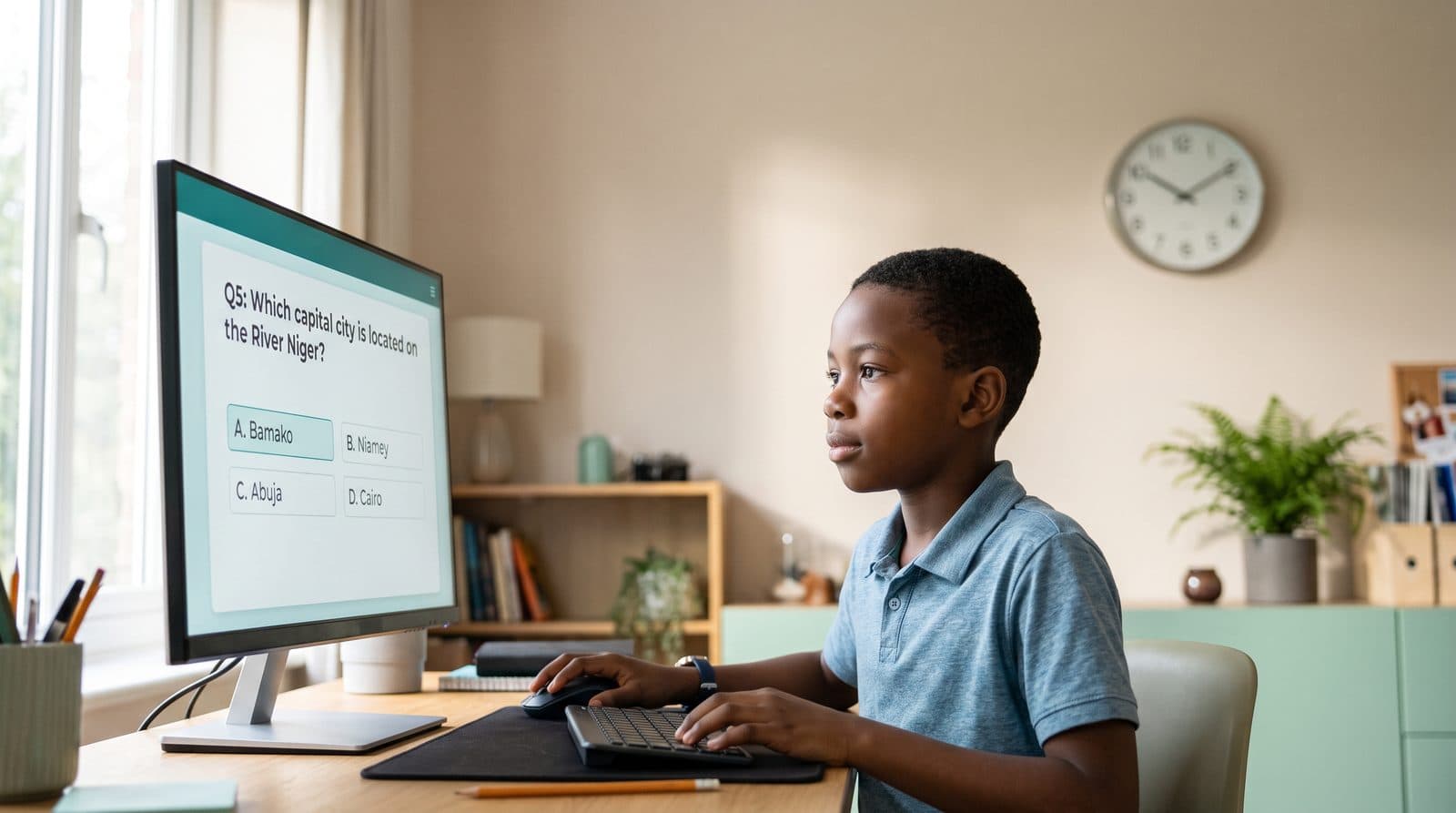
The unfamiliar. For CBT exams like the Lagos screening (and the NCEE as Nigeria moves toward computer-based testing), the screen itself is a variable: navigating between questions, reading a diagram on a monitor, answering by click instead of pencil. Routine for adults; genuinely foreign for a ten-year-old meeting it for the first time on the most important morning of their year.
What actually works: rehearse the pressure, not just the content
Here's the encouraging part of the same research: pressure stops being disruptive when it stops being novel. Beilock's work found that practising under even moderate stress helps people perform when the real pressure arrives. The nervous system learns that this feeling — clock ticking, silence, no help coming — is survivable, then familiar, then almost boring.
That points to a different preparation checklist:
- Make some practice timed — properly timed. Not "about an hour," but the real exam's timing, enforced, with no pausing. Once or twice a week is enough to start.
- Practise the format, not just the questions. If the exam is computer-based, some practice should happen on a screen with real navigation — not paper pretending to be a screen.
- Debrief pace, not just score. After a timed session, ask two questions before looking at the marks: Did you finish? Where did the time go? A child who scored 60% but finished calmly is often closer to ready than one who scored 70% by taking double time.
- Train the recovery. Teach one simple ritual for hard questions — flag it, one breath, move on, come back later. Then let them rehearse that ritual under a real timer until it's automatic.
None of this requires more hours than you're already spending. It requires that some of those hours feel like the exam.
See where your child actually stands — in five minutes
This is exactly what Qualificant is built for: full timed CBT simulations that look and feel like the real NCEE, Lagos State screening, and CAT4 — with instant explanations after every question, and a parent report in plain language: pacing, composure, accuracy, completion.
You can feel the difference in five minutes. Try five real exam questions free — no signup, no data collected. Watch how your child handles the clock, not just the content. That one observation will tell you more than another stack of worksheets.
Qualificant is an independent exam-readiness platform and is not affiliated with or endorsed by NECO, Lagos State, or GL Assessment.