The ideas behind every question type
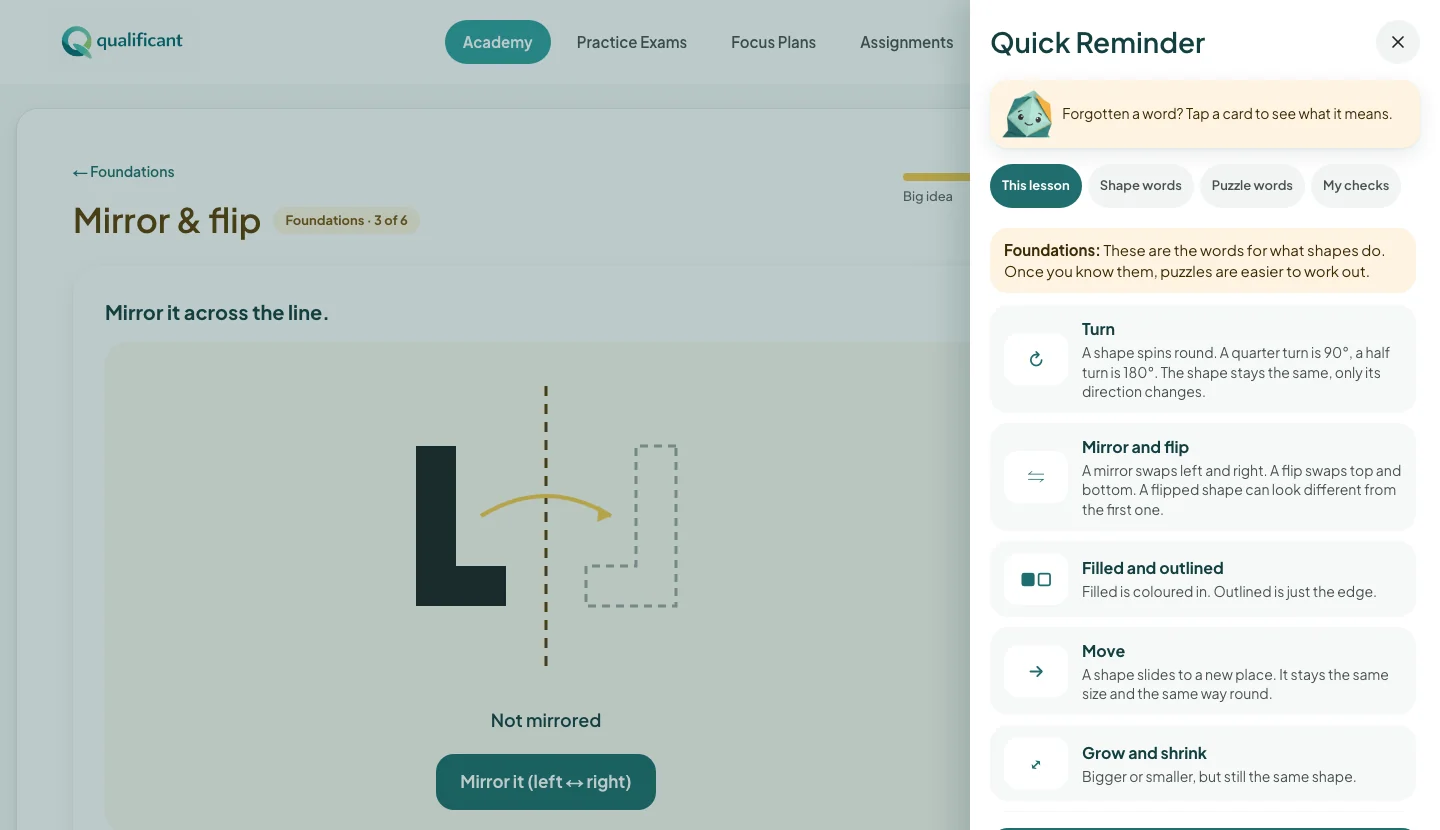
Foundations lessons teach the words puzzles are built from: turn, mirror, fill, sequence. After that, a CAT4 grid stops looking like a code.
CAT4 Academy · for ages 9 to 12
Short, guided lessons teach the thinking behind every CAT4 question type, from turns and mirrors to number rules. Then your child practises on the same kind of screen they'll see on test day.
Available now: Level C lessons (about ages 10 to 11) and the full Level D practice test. Level D lessons are coming next. 7-day free trial, no payment to start. See what's included

Try it with your child
Start with a Foundations warm-up, then a real CAT4 question type. This is exactly how lessons feel inside the Academy.
Tap a button and watch what swaps.
Nothing has swapped yet.
Look along each row, then down each column.

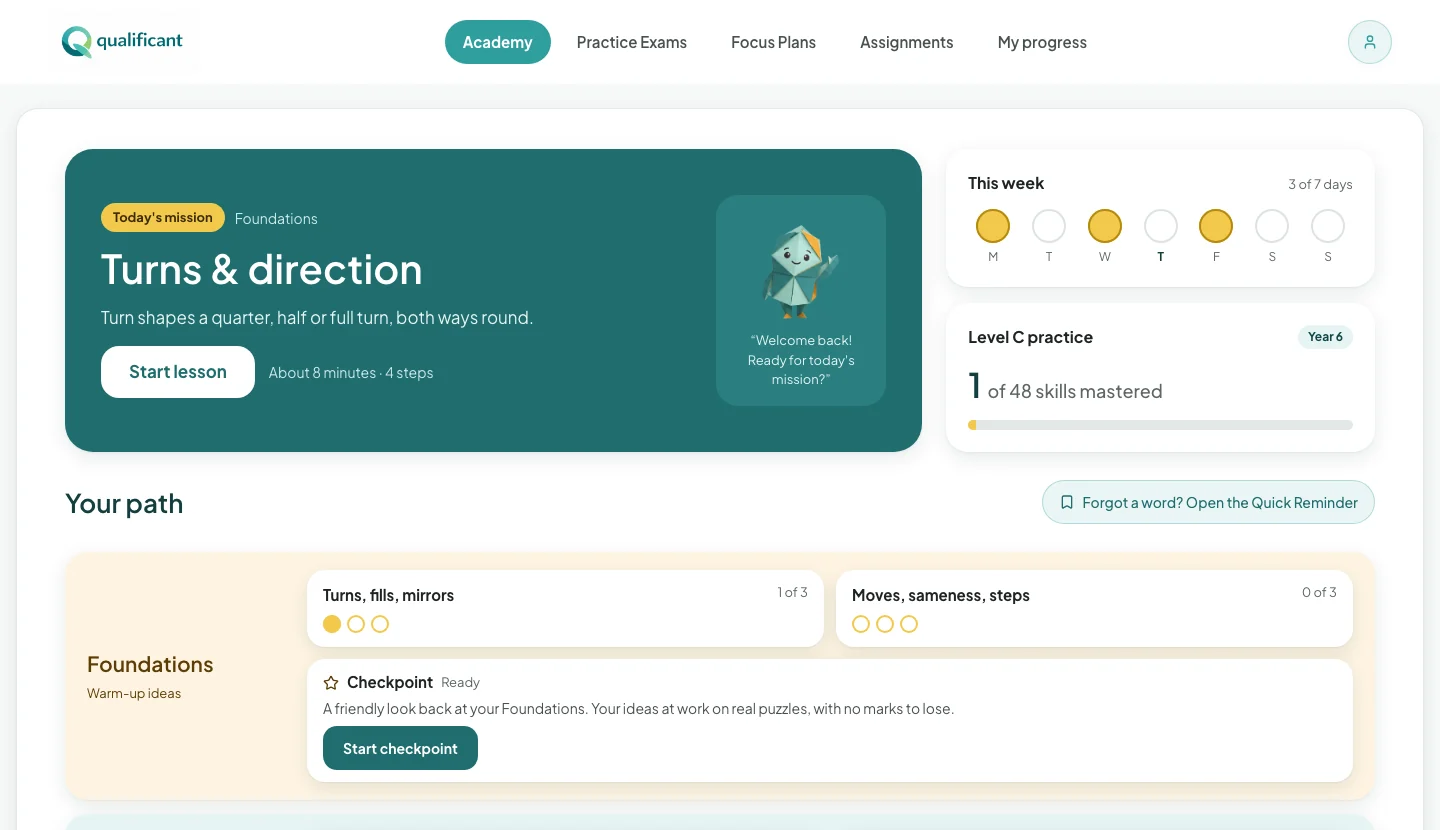
The full path has 8 CAT4 question types, each taught step by step, with Quali alongside. Save your child's progress and they'll start right where they left off.
Start Free TrialSave progress and unlock the full path. Parents sign up; your child's profile is added only with your consent.
Not sure which level? See the CAT4 levels.
Why it helps
There's no syllabus. Children meet unfamiliar puzzles, against a clock, on a screen. The Academy takes the surprise out of all three, without promising a score.

Foundations lessons teach the words puzzles are built from: turn, mirror, fill, sequence. After that, a CAT4 grid stops looking like a code.
Children answer the same way they will on the day: tap an option, move on, keep a steady pace. The format feels normal by the time it counts.
Wrong answers get a kind explanation and another look. Children see what they've mastered, not a mark. Confidence comes from understanding why.
How a lesson works
Every skill follows the same rhythm, so your child always knows what comes next. Help fades step by step until they can do it alone.
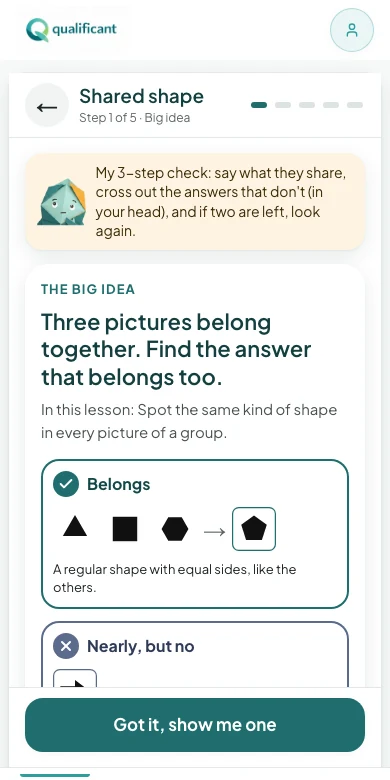
Quali explains the idea and the 3-step check to use on every puzzle.
Animations and hands-on activities show the rule happening.
Prompts walk through the first puzzle, then step back.
How will the paper look when it is unfolded?
 Let's look againThe punch goes through both layers. Unfold it and there's a hole on each side of the fold, at the same height.
Every answer gets an explanation, right or wrong. Here: one fold, one punch.
How will the paper look when it is unfolded?
A fresh question with no hints. A short check marks the skill as mastered; spaced reviews make it stick.
Which number comes next?
Let's look againLook at how each number changes: 3, 6, 12, 24. Each one is double the one before, so next comes 24 × 2 = 48.Show me howNext
Feedback that teaches
When your child picks the wrong answer, the puzzle stays on screen and Quali explains what to look at. No red, no buzzer, no lost points.

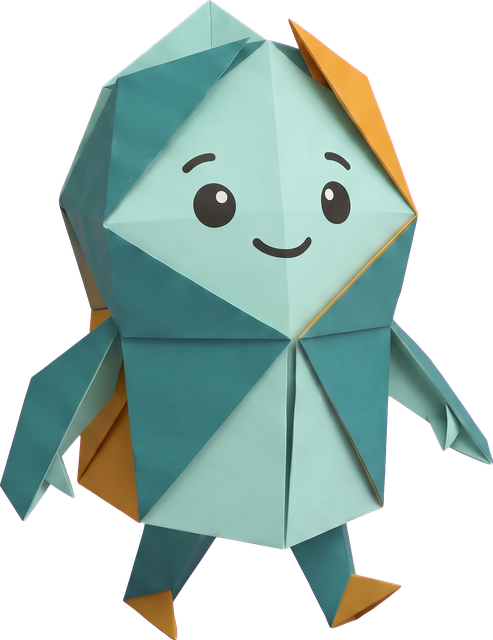
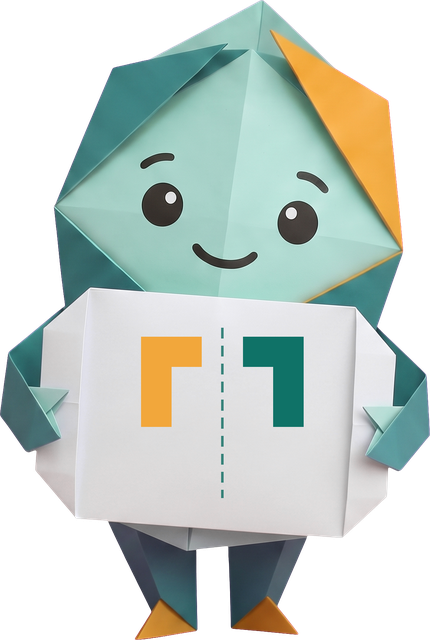
Quali is folded from paper, which is fitting, because folding is one of the puzzles. Quali greets your child by name, explains each idea in one or two short sentences, and cheers when a skill clicks.
A guide, not a distraction
Quali never appears while your child is choosing an answer, and never inside a timed test. When it's time to think, the puzzle has the screen to itself.
 Checksa 3-step routine
 Foldspaper puzzles
 Turnsshapes, one quarter at a time
 Encouragesafter a tricky one
Everything CAT4 covers
CAT4 looks at how children think with words, numbers, shapes and space. The Academy has a lesson path for each question type, colour-coded so children always know where they are.


Starts with Foundations. Six short warm-up lessons (turns, fills, mirrors, moves, sameness and steps) give your child the vocabulary every CAT4 puzzle is built from.
Which level?
CAT4 comes in levels by age, from Level X for six-year-olds to Level G for older teenagers. Your child's school will tell you which level and when. Here's how the levels around ages 9 to 13 usually line up.

| CAT4 level | Usually taken in | In the Academy |
|---|---|---|
| Level B about age 9 to 10 | Year 5 · Grade 4 | Planned |
| Level C about age 10 to 11 | Year 6 · Grade 5 | Lessons ready now |
| Level D about age 11 to 12 | Year 7 · Grade 6, often at the start of secondary school | Lessons coming next Practice test ready now |
| Level E about age 12 to 13 | Year 8 · Grade 7 | Planned |
GL Assessment describes CAT4 as the most widely used reasoning test in the UK and Ireland, and international schools around the world use it too. It isn't a pass or fail exam. Schools use it to understand how a child thinks and learns best.
Every school sets its own timing, so ask yours which level your child will sit and when.
Sources: GL Assessment CAT4 product information and level guide. Ages and year groups are typical, not official.
For parents
Ten focused minutes beats an hour of worksheets. The Academy picks the next lesson for your child and keeps you in the picture.

When they're ready
Lessons build understanding. Practice tests build stamina. When your child is ready, they sit a full timed simulation across all four batteries, set out the way the real test is.
72 minutes is the timed test time, not the whole sitting: on the day, instructions and practice examples add a little more. Our practice material is original and indicative, not official CAT4 questions.

One plan covers it all. Every CAT4 plan includes the full Academy and the practice tests.
See CAT4 plans and pricesSafe for children
The puzzles on this page collect nothing about your child. No name, no age, no account.
Only a parent can create an account. A child profile is added with your recorded consent.
We design for UK and EU GDPR expectations for children's data and follow local data protection law where families use us.
Not affiliated with or endorsed by GL Assessment. Practice is indicative, not an official result.
CAT4 is a trademark of GL Assessment. Qualificant is independent and not affiliated with or endorsed by GL Assessment. Practice materials are original and indicative; they are not official CAT4 questions and do not produce official results.
Questions parents ask

GL Assessment, which makes CAT4, advises against coaching for the test. The Academy doesn't coach answers or teach tricks for a score. It explains what each puzzle type is asking and lets your child get used to the on-screen format, so test day is familiar rather than a surprise.
We don't promise scores. CAT4 measures reasoning, and no course can guarantee a result. What we offer is understanding, familiarity and calm, which helps children show what they can really do.
Level C is usually taken around Year 6 (Grade 5), when children are about 10 to 11. Level D is usually taken around Year 7 (Grade 6). The Academy lessons are ready for Level C now. Level D lessons are coming next, and the Level D practice test is available now.
Schools decide their own timing. CAT4 is often taken when a child joins a new school, at the start of secondary school (Year 7 or Grade 6), or as a regular check in key year groups. Ask your school which level and when.
Yes. When your child is ready, timed practice tests cover all eight question types in three parts, on a test-style screen, with no pausing. Our Level D practice test has 168 questions over 72 minutes of timed practice. A review comes afterwards.
A lesson takes about eight minutes. Three or four lessons a week is plenty. Today's mission always shows the next one, so there's nothing to plan.
No. Children see encouragement, their next lesson and which skills they have mastered. Detailed progress is for parents only.
No. The puzzles on this page run in your browser with no account and no personal details. Start a free trial only if you want to save progress and unlock the full path.
No. Qualificant is independent and is not affiliated with or endorsed by GL Assessment. CAT4 is a trademark of GL Assessment.

Try two puzzles now. If your child enjoys it, start a free trial and carry on with today's mission.