The 4 parts of the CAT4 — and the thinking skills each one builds
September 16, 2026
In our last guide we said the CAT4 is a test of how your child thinks, not what they've memorised. Now let's open it up and look inside.
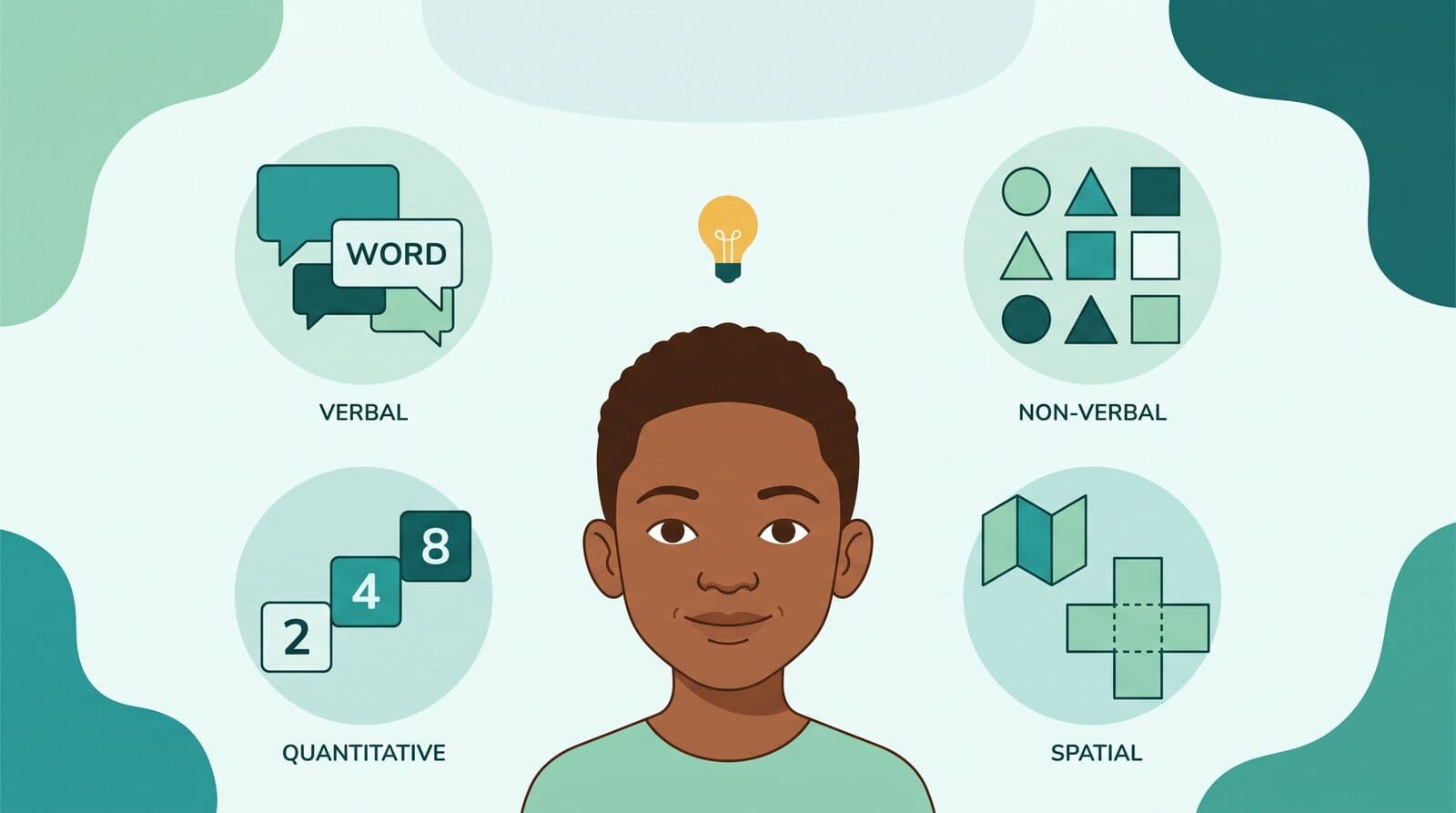
The test is built from four "batteries" — think of them as four different lenses on your child's thinking. Together they're made of eight short tests (GL calls them subtests). Each battery looks at a genuinely different kind of reasoning, which is why the CAT4 gives a profile rather than a single number: most children are stronger in some areas than others, and that's completely normal.
1. Verbal Reasoning — thinking with words
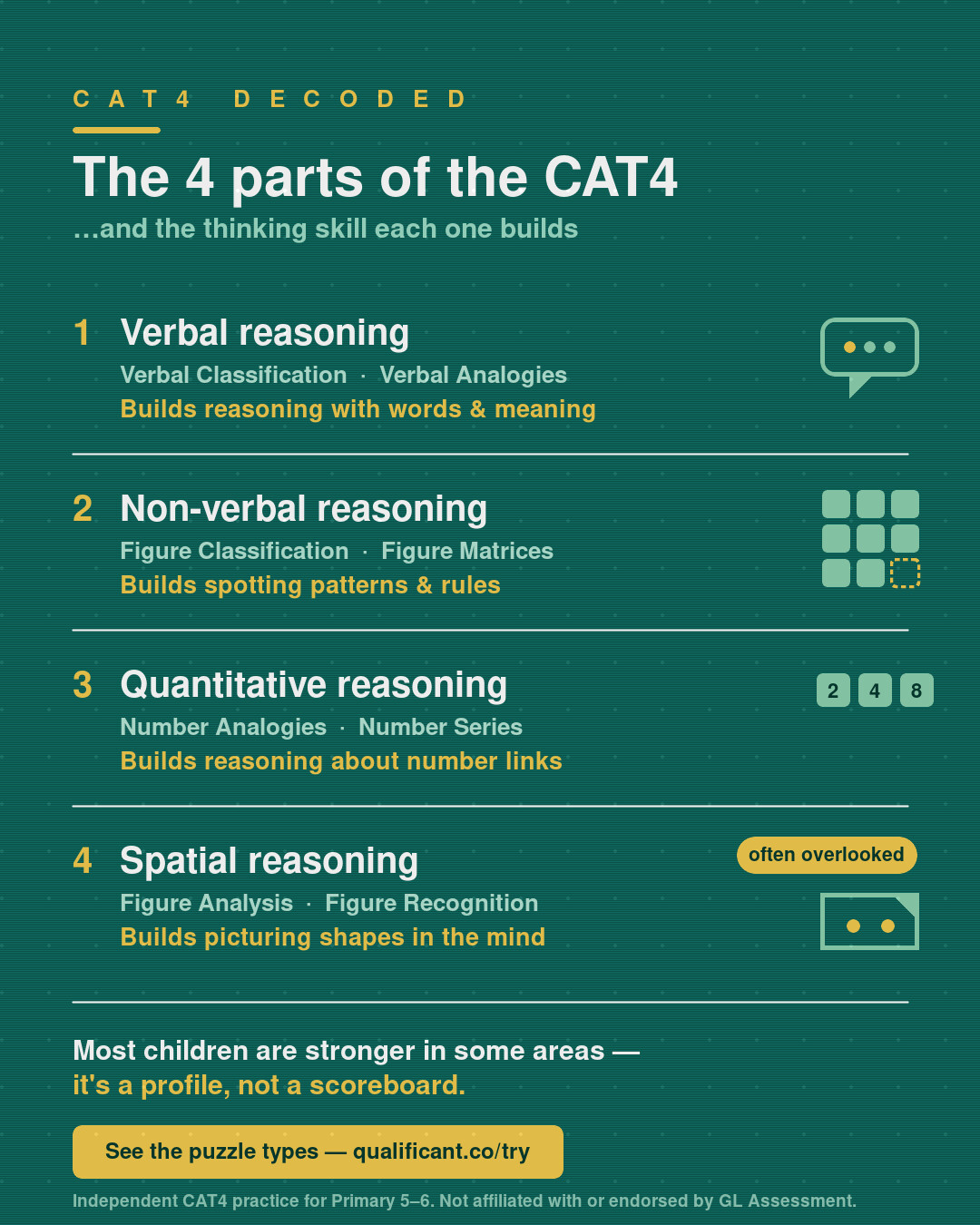
What it looks like: finding the odd word out, or completing pairs like "hot is to cold as up is to ___." The two short tests: Verbal Classification and Verbal Analogies. The real skill: how well your child reasons using language — spotting how ideas relate, seeing categories, understanding shades of meaning. It's the engine under essay-writing, comprehension, and following a layered explanation. This battery leans on vocabulary, so a child who reads widely — in any language — tends to find it easier.
2. Non-Verbal Reasoning — thinking in patterns and shapes
What it looks like: a grid of shapes with one missing to complete; or finding which figure doesn't belong. The two short tests: Figure Classification and Figure Matrices. The real skill: pure problem-solving with no words and no numbers to lean on — just "what's the rule here, and what comes next?" Because it doesn't depend on language, it's often the fairest look at raw reasoning, especially for a child whose first language isn't English.
3. Quantitative Reasoning — thinking with numbers
What it looks like: number sequences to continue (2, 4, 8, 16, …) or number relationships to complete. The two short tests: Number Analogies and Number Series. The real skill: reasoning about how numbers relate — different from arithmetic. Not "can you calculate 8 × 7?" but "can you see the rule connecting these numbers and use it?" A child can be quick at sums and still find this tricky, because it rewards spotting relationships, not speed of calculation.
4. Spatial Reasoning — thinking in three dimensions
What it looks like: picturing a folded, hole-punched paper and predicting where the holes appear; or finding a shape hidden inside a busier one. The two short tests: Figure Analysis (paper-folding) and Figure Recognition (embedded figures). The real skill: picturing and moving objects in the mind's eye. It's the quietest battery on a report and the most overlooked — yet spatial reasoning is one of the strongest early signals for success in science, technology, engineering, maths and design. It's also wonderfully trainable through play — building, folding, drawing.
The eight tests at a glance
| Battery | Short tests inside it | The thinking it builds |
|---|---|---|
| Verbal | Verbal Classification · Verbal Analogies | Reasoning with words and meaning |
| Non-Verbal | Figure Classification · Figure Matrices | Spotting patterns and rules |
| Quantitative | Number Analogies · Number Series | Reasoning about number relationships |
| Spatial | Figure Analysis · Figure Recognition | Picturing shapes and space in the mind |
(A full CAT4 is roughly 168 short questions — eight short tests of about 8–10 minutes each, usually spread across three shorter sittings, so no single sitting is exhausting for a child.)
Why the profile is the point
The CAT4 is looking for a shape, not a score. A child might be strong in Non-Verbal and Spatial but a little behind in Verbal — a very common profile, and often a sign of a strong thinker who simply needs more words in their world. Another child might be the mirror image. Neither is "better." The profile tells a school how to teach this particular child well.
What actually helps — per battery
Verbal → reading together, talking about why words go together, word games. Non-Verbal → puzzles, "what comes next?" games, spot-the-difference. Quantitative → number patterns, simple sequences, noticing maths in daily life. Spatial → building, folding, drawing, construction sets — hands, not screens. None of that is cramming; it's the slow, enjoyable building of real reasoning.
See the puzzle types for yourself
At Qualificant, our reasoning practice for Nigerian Primary 5–6 learners is organised around exactly these skills — with calm, animated explanations that show a child how each type of puzzle works. Try a free taster at qualificant.co/try.
Next up: your child has sat the test and a report has landed in your inbox — SAS, stanine, NPR, group rank. In the final guide of this series, we translate every one into plain English.
Qualificant is an independent exam-readiness platform and is not affiliated with or endorsed by GL Assessment. We don't guarantee scores or admission — we help children develop genuine reasoning and walk in calm and familiar with the format.